Terry Dactyl Traces Queer Survival From the AIDS Crisis to 2020 Seattle
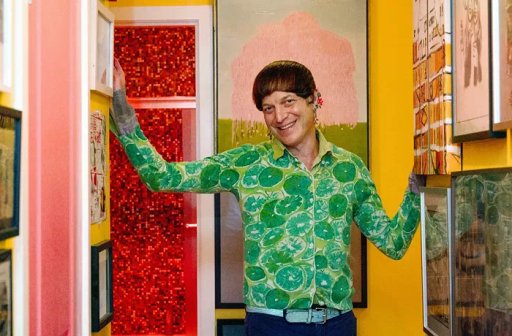
Mattilda Bernstein Sycamore’s signature style rolls and whirls with long sentences—descriptions as artfully enduring as her characters. [This profile originally appeared in our sister pub The Stranger. -eds] Mattilda Bernstein Sycamore takes long and meandering walks through Capitol Hill most days. From the height of summer to the depths of winter, if the sun is out, she’s soaking in it. On these walks during the pandemic lockdown, Terry Dactyl came to her. She couldn’t write it immediately because she was working on her memoir, Touching the Art, which came out in 2023. Before that, there was The Freezer Door, Sketchtasy, So Many Ways to Sleep Badly, among other novels and memoirs, plus six anthologies and another currently in the works. She’s a prolific queen because writing is survival, she says. “Writing is my process of staying alive,” Sycamore says. “It is embedded in how I live. Specifically, writing everything that I dream of, and everything that fails me, all of the emotional reality. Often, there are things I’m afraid to say, and then I put them in my writing, and they’re said. Then I can say it! I can read it in the book, and people aren’t that shocked by it. Often, what people are shocked by has nothing to do with what I’m afraid of. When I write the things that I think, ‘If I write it, I might die,’ and then I write it and I don’t die, that’s part of the process of staying alive.” Sycamore goes deeper still about this question of life or death, how it has been quite literal for her, and how writing has shown her how to live differently in the world. “When I was a teenager, growing up in a world that wanted me to die or disappear, I had to project invulnerability in order to survive. There was no other way. That was just reality, you know? I needed that invulnerability.” Once upon a time, The Stranger’s Homosexual Agenda column described Sycamore as a “gender-fucking tower of pure pulsing purple fabulous,” and I’d say that description stands, in case you need context for why she grew up thinking the thickest of skins was a way to stay alive. But that’s changed for her. “Now, vulnerability is how I connect with people and my work,” Sycamore says. “I’m always writing toward the gaps, the moments of failure or frights or fear, anxiety, loneliness, and the moments that allow us to survive. Those sudden moments of connection in the world, when we move deeper into breath, whatever creates that. I think often what creates that [breath] is being honest about all the depth of everything that weighs us down.” Terry Dactyl is filled with these moments, one after another, and it’s what makes the novel powerful and compulsively readable, especially as she essentially restarts the story halfway through. But we’ll come back to that. The book follows our protagonist, Terry Dactyl, from childhood to midlife. Terry is a trans girl from Seattle’s Capitol Hill neighborhood who gets into Columbia University, then drops out after a year and becomes a club kid in New York City in the ’90s and early 2000s. When COVID-19 descends, she returns to Seattle, where she seeks connection with a neighborhood and a city she finds utterly changed. That connection is sought through long meandering walks while in the midst of chronic pain that catches up with her after years of self-medicating through drugs, mostly. Without them, Terry finds her body ravaged by what she’s lived through. “That is how the book started for me. I was just walking around in Seattle, I guess in 2020 or 2021, and this character came to me. I started thinking about all these details about her life. Like, her relationship with her mother. I picked the house where she grew up. Her first few years, she was living at the Biltmore. Then she moved to 12th Avenue. It was all being mapped out as I was walking around, and finishing my previous book, Touching the Art. It just kept spinning in my head for at least six months before I wrote a word.” The book starts in 2020 in New York City. The story then takes us to the AIDS crisis of the ’80s and ’90s in Seattle and New York, then back to the COVID-19 pandemic and the crisis of police brutality in this country that surfaces to the mainstream (again). “Terry’s experience of the world is formed through trauma in its fullest sense. Growing up in the midst of the AIDS crisis, this little kid watched as all of her mother’s friends—who are her friends and her role models—were dying before her eyes. The end of the book [depicts a] traumatized sense of time, because trauma is the pulse. It’s a living, breathing pulse, a three-dimensional experience, or maybe it’s a six-dimensional experience because it gives you all of these ways of thinking and experiencing the world that might not be available to other people. Then all the people she knows in New York die of AIDS, including her girlfriend, who is the central figure in the little world of club kids that she’s a part of. So, in some ways, the book is about what happens for the people who survived.” Sycamore heightens Terry’s experience through her longest sentences yet (which is really saying something since Sycamore’s writing is marked by a signature style that rolls and whirls with long sentences). While reading, I imagined these sentences taking on the rhythm and breath of Sycamore’s hours-long daily walks. “The first long sentence is the first sentence [of the book]. It’s, like, half a page. [Terry’s] on the dance floor at the Limelight, and she’s enthralled with Sid [who becomes her girlfriend], who she meets on the dance floor, and Sid is doing this really intense, surprising performance. In the middle of this crowded dance floor, [Terry is] in her own world. I wanted the sentences to be their own world. Those sentences allow the voice to take possession, and the voice and the character are what drive the book.” By the time Terry returns to Capitol Hill, her outer world becomes simpler, but her inner world becomes richer than ever. I lived in Capitol Hill during the pandemic, and reading this book was a visceral memory returned: If you were there, you remember the flash bombs and tear gas and helicopters all night. The terror of all that, on top of the nerve-wrecking walks in the early days when fuckers didn’t wear masks (I’m still mad at them) or keep a distance, and we were otherwise trapped inside. And in all that rage and fear and loss, Terry finds a moment of what Sycamore called “public love.” “When Terry experiences it in the book, is when everyone’s yelling for essential workers, and she starts a chant, black lives matter, abolish the police. That’s when she feels, finally, connected to this neighborhood where she grew up. She grew up there, but it’s not that place anymore. When she grew up, she was a little kid wandering around [in her own house], and all these queens [friends of her mom’s] were like, hey, girl. She was this trans girl coming of age, there was a sense of communal possibility in everyday experience. But that’s gone. So when she feels it, it’s in those moments of screaming out as loud as she can, and blowing her whistle to the tune of black lives matter, abolish the police, and then when people join in, that’s the key. And when someone yells, I love you, and it’s just a random person, it’s only a moment, they don’t get to know one another: That’s where the communal possibility exists. That’s love as a public force. That ritual for Terry is her way of connecting politically with the world, but also with her own history of this neighborhood that formed her, and that now feels, in some ways, like somewhere she had never been before.” For those that need a more fleshed-out introduction to this local legend, Sycamore is a self-described “faggot, a queen, genderqueer, trans, and nonbinary,” and she’s also an activist and anarchist. She’s resisted traditional systems from her earliest beginnings, growing up in Washington, D.C., and came into herself in San Francisco working with ACT UP (AIDS Coalition to Unleash Power). This beginning shaped her work and her voice, and certainly helped shape and inspire Terry Dactyl and her experiences in the book. “All of us experienced the beginning of the pandemic, and that moment of absolute fear, and also, a moment when we were all together. That was the rhetoric, but it also felt that way, because no one knew what the fuck was going on. Everyone felt vulnerable, and in that vulnerability, there was a possibility. That possibility has been squandered. It’s gone. It’s over. It ended as soon as businesses started reopening. Now we’re living in that loss. But I think that moment of communal possibility, that’s what I mean by love as a public force.” Lucky for us, we’re alive to take in this latest work from a local heartthrob and a writer who has been recognized by practically every major and minor queer and radical author of the last 20 years. Make way for Sycamore’s latest in your minds, your hearts, and your purses, honey. She won’t let you down. Mattilda Bernstein Sycamore appears in conversation with Leni Zumas, Powell's Books on Hawthorne, 3723 SE Hawthorne, Tues Jan 13, 7 pm, FREE, all ages.